How LC-elastomers turned into the actuators, we know today
Erstellt von Alexey Eremin vor 11 Tagen um 09:52 Uhr:
Rudolf Zentel,
Dept. of Chemistry, Johannes Gutenberg University Mainz, Duesbergweg 10-14,
D-55128 Mainz, Germany
zentel@uni-mainz.de
The first paper about LC-elastomers was written by H. Finkelmann [1] in 1981. In the next 10 years 1990 the field “flourished” and in about 1990 a lot of papers on LC-elastomers were available (see [2] for an early review and [3] for an more recent one). But it lasted till 1991 till “Nematic liquid single crystal elastomers“ [4] were presented by Finkelmann, which are the basis for LC-actuators (in combination with a phase transition) today. So why did this take so long and what were the interests in LC-elastomers during the first 10 years of their existence?
The interest was -besides the fact- that they were new, based on the ideas of de Gennes [5] (see Fig. 2 in the Blog: The very early days of LC-elastomers (their “invention”), which predicted a coupling of the anisotropic conformation of the polymer (network) chains and the director of the liquid crystalline phase. Thus it should be possible to orient (and reorient) the LC-director by stretching the elastomer in different directions [2], but also to change the dimensions of the elastomer by switching in in electric fields. Now the first part (orientation of the director by mechanical deformation) could be easily accomplished [2]. Further research directions pointed here towards the use of chiral phases (cholesteric and chiral smectic C* systems [2]) to modify selective reflection [6] or to obtain piezo-effects [7]. The macroscopic change of the sample dimension (that is what modern LC-actuators do) showed, however, to be more complicated, because the authors working on the topic were looking for an isothermal shape change as response to a reorientation of the director. That is “shape change” in response to electro-optic switching (see Fig. 1). And electro-optical switching was possible in uncrosslinked nematic LC-polymers [8].
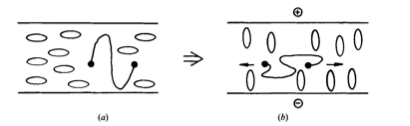
Fig. 1: Schematic sketch of the change of the preferred chain conformation perpendicular to the nematic director during switching of the director [9] between ITO coated glass plates from the homogeneous to the homeotropic orientation. This has to lead to an expansion of the elastomer parallel to the glass plates.
Looking a bit more closely to Fig. 1 makes the problem visible. A switching of the director orientation has to lead to a change of the elastomer shape, but this is not possible because the sample is “glued” to the ITO-coated glass slides. Or, the electro-optical cell keeps the sample size constant and prevents thus the electro-optical switching. And that is what is observed [9]. And so the “absence” of switching in a nematic sample of fixed shape proves a strong coupling of director and chain-anisotropy.
To circumvent this problem, Zentel cut small pieces of an nematic LC-elastomer and dispersed them inside a cell for electro-optic measurements filled with a low molar mass liquid crystals [9]. These measurements showed that a shape change is possible, but the setup was complicated and the deformations not too big. So, these shape-change experiments did not look too promising and were not extended further except at later times by Urayama [10]. (It should be stated here that the situation is different in chiral smectic C* phases [7], because the stronger force to induce electric switching and of switching on a cone)
The new concept for mechanical actuators came from Finkelmann and was a preparation protocol to prepare large LC-elastomer pieces, which consist of a LC-monodomain [4]. For these monodomains a shape change could be induced by heating them through the phase transition into isotropic phase (see Fig. 2). In this way the director orientation (and thereby the anisotropy of the polymer chains) was changed by a phase transition (induced by heating). Fig. 2 shows that the size change induced in this way follows the expected variation of the order parameter in the nematic phase, which changes most strongly at the phase transition temperature [4]. By optimization of the preparation protocol quiet large size variations could by obtained for such samples while varying the temperature.
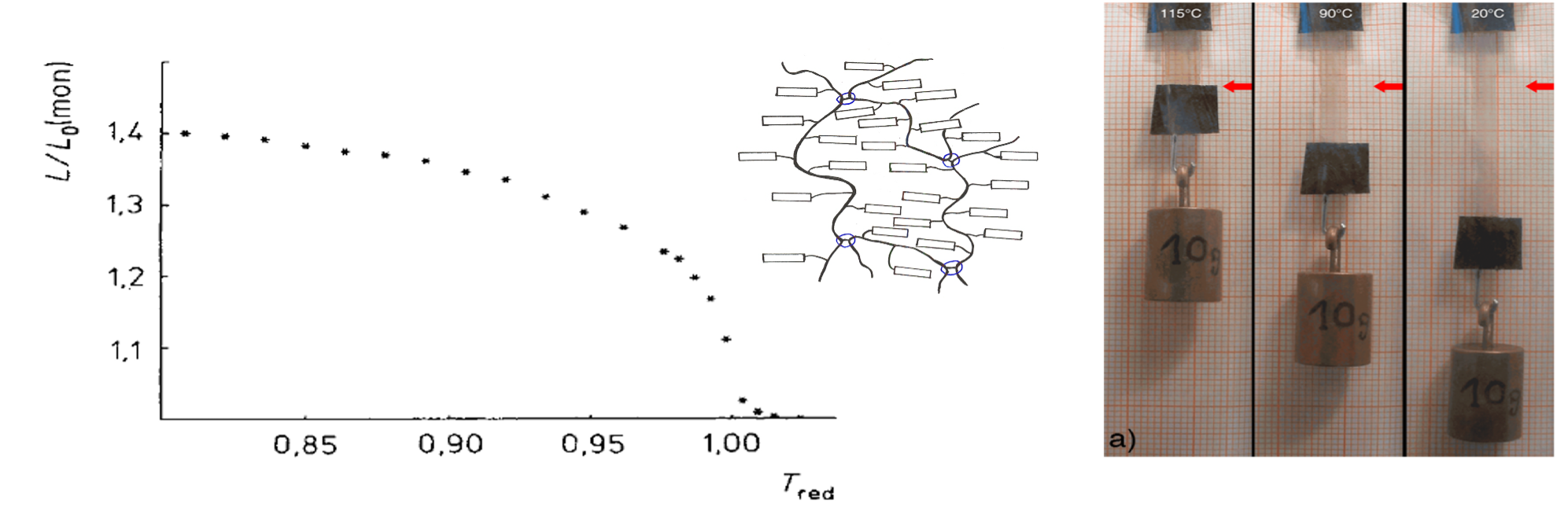
Fig. 2: (left) Change of the sample length with temperature for a Nematic liquid single crystal elastomers (temperature dependence taken from ref. [4]); change of sample length for an optimized sample (reproduced from [3], p. 63)
The realization of these mono-domain LC-elastomers (“Nematic liquid single crystal elastomers“) got possible by a two-stage crosslinking process, as presented in Fig. 3.
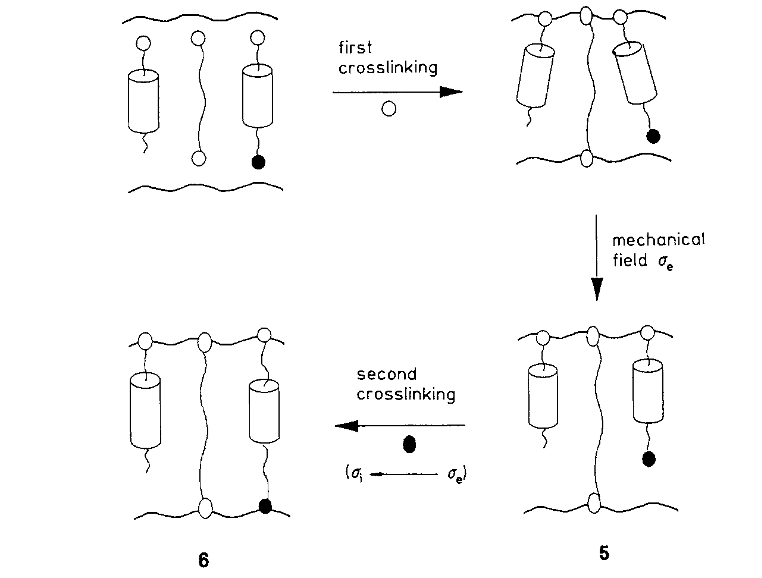
Fig. 3: Two stage process for the preparation of “Nematic liquid single crystal elastomers“) [4]; at first the reaction mixture is isotropic (diluted with solvent), for the last step it is solvent free and liquid crystalline
It is important in this context to remember that mesogens (in the LC-phase) and isotropic polymer chains do not mix (see Blog 1: The very early days of LC-elastomers (their “invention”). So the mesogens and the siloxanes have to be hydro-silylated and crosslinked in an isotropic solvent to assure proper chemical reaction in a homogeneous medium. But in the isotropic solvent, it is not possible to orient the mesogens uniformly (the final network obtained would -under these conditions- be a polydomain sample [1,2]). Thus, in the two stage process the build-up of the elastomer is made in two steps. At first the mesogens are linked to the polysiloxane chains in the isotropic phase and also part of the crosslinking is done there. As a result a soft, isotropic, highly swollen network is obtained before the chemical reaction is finally completed. This is now (i) tried (solvent free), whereby it turns liquid crystalline. Then (ii) it is stretched (this leads now to a uniform orientation of the LC-director) and then (iii) it is allowed to react further to allow additional crosslinking to stabilize the LC-mono-domain. By this complicated process LC-elastomer mono-domains can be prepared reproducibly. And they change their shape as the order parameter of the LC-phase changes (Fig. 2). Such a change of the phase transition can also be induced by a photo-isomerization of suitable dyes.
While these “Nematic liquid single crystal elastomers“ make good actuators, it is important to remember that there is a lot of heterogeneity in them. At first part of the network is made in the highly swollen isotropic state and part in the highly stretched bulk state. As result, local chemical heterogeneities of the chemical composition (more or less mesogens per domain) may arise as the solvent is evaporated to reach the liquid crystalline phase (remember: mesogens and chains mix poorly). This shows-up at the phase transition nematic to isotropic, which is smeared out [11]. A detailed study shows that both a local variation of the strain field and of the transition temperature have to be considered [11] to describe these elastomers properly.
References
[1] Liquid crystalline elastomers - A new type of liquid crystalline material
H. Finkelmann, H.-J. Kock. G . Rehage, Makromol. Chem. Rapid. Commun. 2, 317 (1981)
[2] Liquid crystalline elastomers,
R. Zentel, Angew. Chem. Int. Ed. Engl. Adv. Mater. 28, 1407 (1989), Adv. Mater., 321(1989)
[3] Liquid Crystal Elastomers: Materials and Applications, W. de Jeu, (eds)
Adv Polym Sci 250 (2012);
[4] Nematic liquid single crystal elastomers,
J. Küpfer, H. Finkelmann, Makromol. Chem., Rapid Commun. 12, 717 (1991)
[5] The Physics of Liquid Crystals, P. G . de Gennes. Clarendon Press. Oxford
1975.
[6] Tunable Mirrorless Lasing in Cholesteric Liquid Crystalline Elastomers,
H. Finkelmann, S. T. Kim, A. Muñoz, P. Palffy-Muhoray, B. Taheri,
Adv. Mater., 13, 1069 (2001)
[7] Ferroelectric liquid-crystalline elastomers
M. Brehmer, R. Zentel, G. Wagenblast, K. Siemensmeyer
Macromol. Chem. Phys. 195, 1891 (1994)
[8] Liquid crystalline side chain polymers and their behaviour in the electric field
H. Ringsdorf, R. Zentel, Makromol. Chem. 183, 1245 (1982)
[9] Shape variation of cross-linked liquid-crystalline polymers by electric fields
R. Zentel, Liquid Crystals 1, 589 (1986)
[10] Electro-Opto-Mechanical Effects in Swollen Nematic Elastomers,
K. Urayama, Adv Polym Sci 250, 119 -146 (2012)
[11] The isotropic-to-nematic conversion in liquid crystalline elastomers, A. Lehar, G. Cordoyyiannis, Z. Kutnjak, B. Zalar, Adv Polym Sci 250, 147 – 186 (2012)