The very early days of LC-elastomers (their “invention”)
Created by Alexey Eremin vor 50 Tagen um 12:05 Uhr:
Rudolf Zentel,
Dept. of Chemistry, Johannes Gutenberg University Mainz, Duesbergweg 10-14,
D-55128 Mainz, Germany
zentel@uni-mainz.de
The first paper about LC-elastomers was written by H. Finkelmann [1]. It dates to 1981, at which time he worked as junior group leader in the lab of Prof. G. Rehage at the TU-Clausthal. This work was soon after extended [2] by him. A bit later (1986), also R. Zentel [3] entered the field. Concerning his status, he was also a junior group leader at the University of Mainz associated with Prof. H. Ringsdorf (for comparison: he was 8 years younger than Finkelmann). While Finkelmann focused more on Physico-chemical aspects (he was working in an Institute for Physical Chemistry), Zentel tried to broader the chemical basis and the molecular structures (for an overview see Fig. 1 and [4]). He was working in Organic Chemistry. Over time, the field “flourished” and in about 1990 a lot of papers on LC-elastomers were available. For recent reviews see especially volume 250 of “Adv. Polymer Sci.” [5] and especially the chapters of Brömmel et al. [6] and Ohm et al. [7]
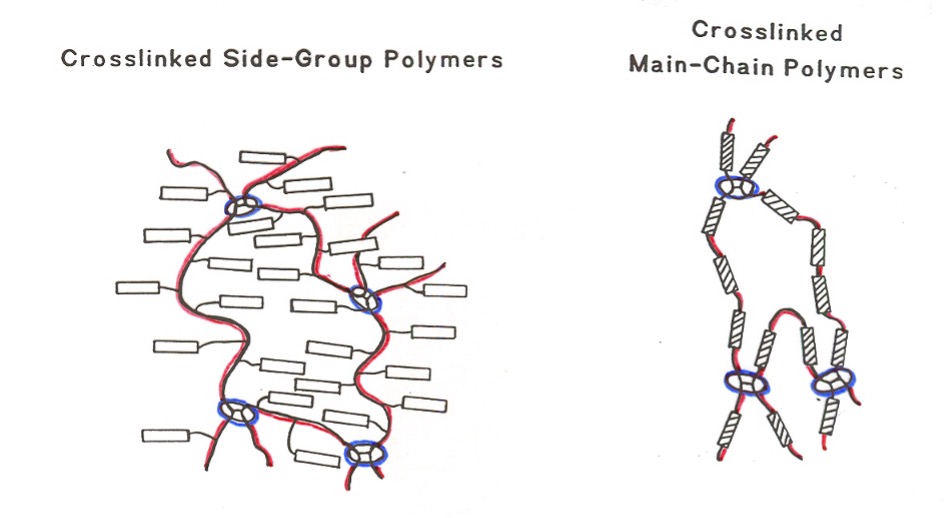
Fig. 1: Schematic representation of LC side-chain and LC main chain elastomers [4]
The polymer chains are marked in red and the crosslinks circled in blue; (original artwork of the author), structure similar to ref. [4]
Now, there was a second route to rise the interest in LC-elastomers. These were the predictions of the properties of LC-elastomers by P.G. de Gennes [8, 9 ](1969 (in French) and 1975), which include also the possibility for a shape change (nowadays most prominent for “actuators”). He was a theoretical physicist and he got the “Nobel price” later on (generally for “theory of soft matter”). However, this work was not cited in the early synthetic papers (how to make LC-elastomers) and -if yes- then not in a prominent way (see [4] for an exception). This aspect has been discussed recently by Jan Lagerwall [10] for the first time. This raises the question of the relevance of chemistry (to really make the materials) and theoretical predictions (of what “great properties they might show) to advance a field. LC-elastomers are a fine example to show that you need both!
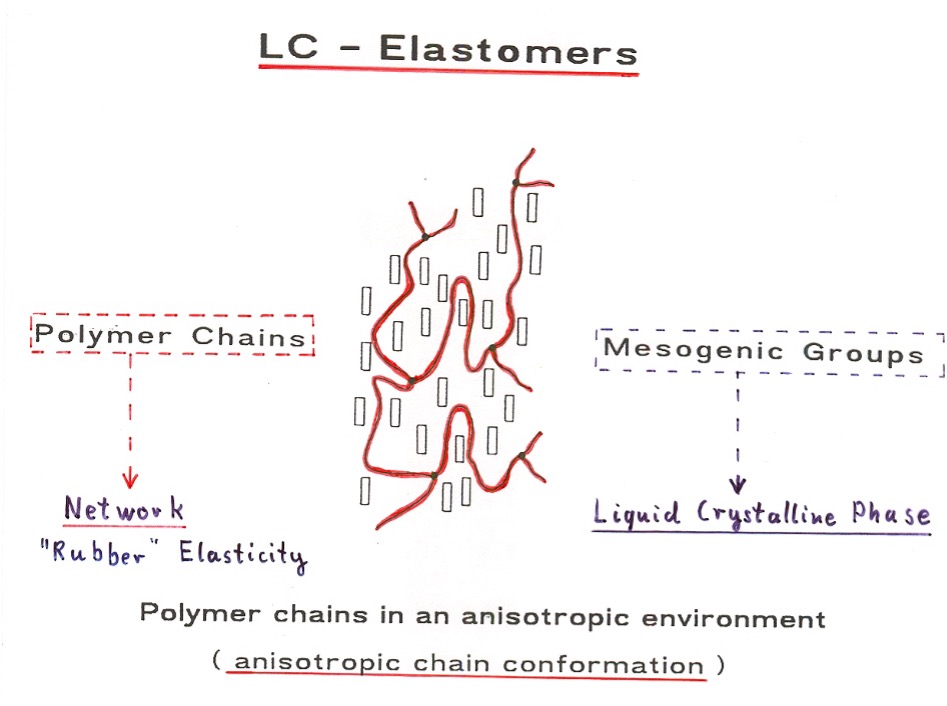
Fig. 2: Schematic picture to demonstrate the interaction of anisotropically oriented mesogens and a crosslinked polymer network (red) according to the concept of de Gennes [8, 9]. In this case (taken from [4]) it is assumed that the polymer chains try to expand parallel to the director of the mesogenic groups, which determines their anisotropic chain confirmation.
My redrawing of the ideas of the general ideas of de Gennes [8,9] are presented in Fig. 2. Independent of the type of coupling (or if there is any) mesogens and polymers will “feel each other”. In this way the polymer chains will acquire some anisotropy in the liquid crystalline phase of the mesogens. And in rubbery polymer networks (elastomers) the chain conformation determines the macroscopic size of the elastomer sample. Thus, any change of the anisotropy must lead to a shape change. So far, so good.
But then it turned out that isotropic networks cannot be swollen with low molar mass liquid crystals in the liquid crystalline phase, see refs. [10 and 11] ( note that [11] is also ref.6 in [4]). So, networks with anisotropic liquid crystalline properties cannot be made so easily (by swelling of classical elastomers). Their preparation requires it either to find (invent) crosslinked elastomers, which are compatible (swellable) with liquid crystalline materials or to invent LC-elastomers directly. And theory cannot tell you, how to solve the challenge. But the chemical preparation [1 -5, 10] of LC-elastomers had solved the problem.
It is interesting that the early ideas of de Gennes had still an outreach, which, however, cannot be tracked today in references. At first ref. [11] cannot be accessed electronically (at least I cannot do so and I have to rely on a paper copy). Secondly, I remember having read an extended abstract from a conference in the 80´ (a paper copy in an “old” library). It described work of some German polymer scientists. They described having prepared a block of a classical elastomer and swollen it in a nematic material (from Merck) in the isotropic phase. This worked well. But as they lowered the temperature, the system phase separated into the nematic phase of the low molar mass compound and a condensed, deswollen elastomer. And because of this fact, they wrote that they could not go on to look for further promising properties.
But this means that prior to 1979 polymer scientist had tried to do something following the predictions of de Gennes. But it had not worked. I myself are however sure that G. Rehage (the mentor of Finkelmann) know about these experiments. And in 1982 (one year after the first paper on LC-elastomers [1]) a paper was published at the TU-Clausthal [12], which shows that the new LC-side group polymers were miscible with low molar mass liquid crystals in the nematic phase. So, the experiments predicted by de Gennes could have been done. However, now LC-elastomers could be made directly [1-7] without the need of mixing/swelling.
As most of the LC-elastomers are based on LC-side group polymers, and as also LC-side group polymers demonstrate the problem of coupling two subsystems (mesogens with anisotropic orientation) and polymer chains (statistical chain confirmation) it is appropriate to discuss them briefly (see Fig. 3).

Fig. 3: LC-side group polymers [i] and the linking of mesogens and polymer coils via a flexible spacer [13]
Polymers (above a critical molecular weight) do not mix with mesogens in the liquid crystalline phase (oligomers, however, might just act like a solvent). This happens because the isotropic polymer coil will reduce the nematic order of the mesogens slightly, whilst -at the same time- the entropy of the isotropic coil is reduced by inducing an anisotropic chain conformation (this corresponds to entropy elasticity on stretching an elastomer). So somehow, both subsystems have to be synthetically coupled to prevent their demixing. On the other side, the coupling should not be too strong, as the orientational tendencies are different. This problem was solved experimentally by introducing the concept of the flexible spacer, which made LC-side group polymers accessible (see [13] for an extended review). The fascinating property of the LC side-chain polymers is, that LC phases get stabilized [13], but if the spacer is removed (Gedankenexperiment) then they would just phase separate.
References:
[1] Liquid crystalline elastomers - A new type of liquid crystalline material H. Finkelmann, H.-J. Kock. G . Rehage. Makromol. Chem. Rapid. Chommun. 2, (1981) 317.
[2] Thermoelastic and photoelastic properties of crosslinked liquid-crystalline side chain polymers W. Gleim. H. Finkelmann, Makromol. Chem. 188, 1489 (1987).
[3] Liquid crystalline elastomers based on liquid crystalline side group, main chain and combined polymers
R. Zentel, G. Reckert, Makromol. Chem. 187, 1915 (1986)
[4] Liquid crystalline elastomers, R. Zentel, Angew. Chem. Int. Ed. Engl. Adv. Mater. 28, 1407 (1989), Adv. Mater., 321(1989)
[5] Liquid Crystal Elastomers: Materials and Applications, W. de Jeu, (eds) Adv Polym Sci 250 (2012);
[6] Preparation of Liquid Crystalline Elastomers: F. Brömmel, D. Kramer, H. Finkelmann, Adv Polym Sci 250, 1-48 (2012)
[7] Applications of Liquid Crystalline Elastomers; C. Ohm, M. Brehmer, R. Zentel Adv Polym Sci 250, 49–94 (2012)
[8] Possibilites offertes par la reticulation de polymeres en presence d’un cristal liquide.
Pierre-Gilles de Gennes. Phys. Lett. A, 28 (11), 725 (1969)
[9] The Physics of Liquid Crystals, P. G . de Gennes. Clarendon Press. Oxford 1975.
[10] Liquid crystal elastomer actuators and sensors: glimpses of the past, the present and perhaps the future,
Jan Lagerwall, Programmable Materials,0,1–42 (2023)
[11] F. Brochard. J. Phys. (Les Ulis, Fr.) 40 (1979) 1049
[12] Phase Studies of Liquid Crystalline Side Chain Polymers Mixed with
Low Molar Mass Liquid Crystals of Similar Structure
H. Finkelmann, H.-J. Kock and G. Rehage
Mol. Cryst. Liq. Cryst., 89, 23 (1982)
[13] Liquid Crystalline Polymers, R. Zentel in: Liquid Crystals, H. Stegemeyer (Editor), Steinkopff Verlag Darmstadt 1994, 103 - 140