Created by Alexey Eremin am 19.12.2025 um 21:22 Uhr:
by Johanna Bruckner (University of Stuttgart)
Located at the Institute of Physical Chemistry at the University of Stuttgart, Germany, the research group led by Dr. Johanna R. Bruckner deals with the fabrication and analysis of hierarchically structured materials. The group advances from lyotropic liquid crystals (LLCs) to hierarchically structured materials by taking advantage of the self-assembled structures of surfactant-, polymer-, or nanoparticle-based LLCs as precursors for well-defined solid systems. One example for this is the preparation of ordered mesoporous materials, such as silicates and metallosilicates, by direct liquid crystal templating (DLCT). In this approach, the continuous phase of an LLC is polymerized around the regularly arranged micelles, producing a precise replica of the LLC. In contrast to conventional templating methods, DLCT results in exceptionally well-defined materials (Figure 1). Due to their large surface area, uniform pore diameters, and active sites, these materials are used for catalysis, adsorption, and separation applications, as well as confinement studies. Another central research focus of the Bruckner group lies on photonic materials which selectively reflect certain electro-magnetic wavelengths through a periodic modulation of the refractive index. Such a modulation is achieved, for example, by drying chiral nematic LLCs with suitable structural and electronical properties while preserving the helical structure (Figure 2). At the heart of the group’s research is the focus on developing a detailed understanding of the initial systems and the underlying processes governing structure formation. Driven by this scientific curiosity, the group also develops new, eco-friendly LLCs and production methods to enhance sustainability and broaden their application potential.
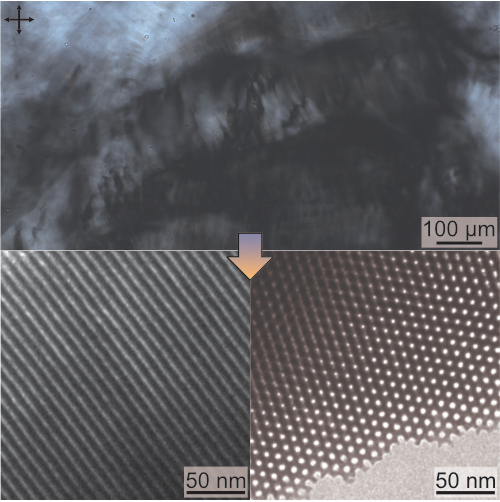
Figure 1. A hexagonal LLC phase, as seen by polarizing optical microscopy (top), which is transferred into an ordered mesoporous material by DLCT. Transmission electron microscopy reveals the uniform cylindrical mesopores (bottom).
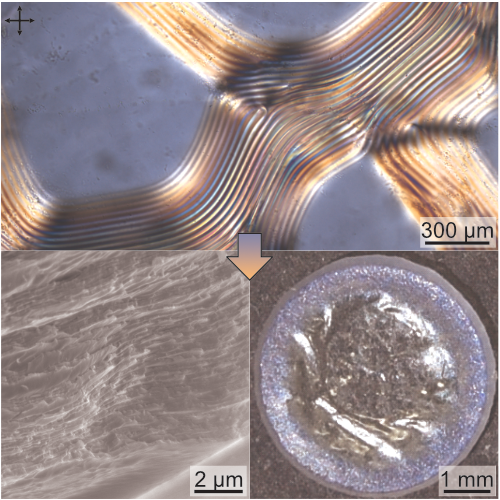
Figure 2. The helical modulation of the director in the chiral nematic phase gives rise to the characteristic finger print texture visible in polarizing optical microscopy (top). If the structure is retained while drying, the helical arrangement can be visualized by scanning electron microscopy (bottom left) and may lead to the selective reflection of visible light, as in the pictured xanthan film (bottom right).