de

Views & News

How LC-elastomers turned into the actuators, we know today

Created by Alexey Eremin vor 15 Tagen um 10:15 Uhr:

Rudolf Zentel, 
Dept. of Chemistry, Johannes Gutenberg University Mainz, Duesbergweg 10-14, 
D-55128 Mainz, Germany
zentel@uni-mainz.de


The first paper about LC-elastomers was written by H. Finkelmann [1] in 1981. In the next 10 years 1990 the field “flourished” and in about 1990 a lot of papers on LC-elastomers were available (see [2] for an early review and [3] for an more recent one). But it lasted till 1991 till “Nematic liquid single crystal elastomers“ [4] were presented by Finkelmann, which are the basis for LC-actuators (in combination with a phase transition) today. So why did this take so long and what were the interests in LC-elastomers during the first 10 years of their existence?
The interest was -besides the fact- that they were new, based on the ideas of de Gennes [5] (see Fig. 2 in the Blog: The very early days of LC-elastomers (their “invention”), which predicted a coupling of the anisotropic conformation of the polymer (network) chains and the director of the liquid crystalline phase. Thus it should be possible to orient (and reorient) the LC-director by stretching the elastomer in different directions [2], but also to change the dimensions of the elastomer by switching in in electric fields. Now the first part (orientation of the director by mechanical deformation) could be easily accomplished [2]. Further research directions pointed here towards the use of chiral phases (cholesteric and chiral smectic C* systems [2]) to modify selective reflection [6] or to obtain piezo-effects [7]. The macroscopic change of the sample dimension (that is what modern LC-actuators do) showed, however, to be more complicated, because the authors working on the topic were looking for an isothermal shape change as response to a reorientation of the director. That is “shape change” in response to electro-optic switching (see Fig. 1). And electro-optical switching was possible in uncrosslinked nematic LC-polymers [8].
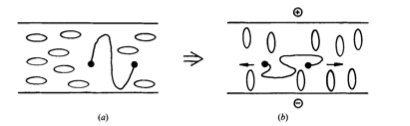

Fig. 1: Schematic sketch of the change of the preferred chain conformation perpendicular to the nematic director during switching of the director [9] between ITO coated glass plates from the homogeneous to the homeotropic orientation. This has to lead to an expansion of the elastomer parallel to the glass plates.


Looking a bit more closely to Fig. 1 makes the problem visible. A switching of the director orientation has to lead to a change of the elastomer shape, but this is not possible because the sample is “glued” to the ITO-coated glass slides. Or, the electro-optical cell keeps the sample size constant and prevents thus the electro-optical switching. And that is what is observed [9]. And so the “absence” of switching in a nematic sample of fixed shape proves a strong coupling of director and chain-anisotropy.
To circumvent this problem, Zentel cut small pieces of an nematic LC-elastomer and dispersed them inside a cell for electro-optic measurements filled with a low molar mass liquid crystals [9]. These measurements showed that a shape change is possible, but the setup was complicated and the deformations not too big. So, these shape-change experiments did not look too promising and were not extended further except at later times by Urayama [10]. (It should be stated here that the situation is different in chiral smectic C* phases [7], because the stronger force to induce electric switching and of switching on a cone)
The new concept for mechanical actuators came from Finkelmann and was a preparation protocol to prepare large LC-elastomer pieces, which consist of a LC-monodomain [4]. For these monodomains a shape change could be induced by heating them through the phase transition into isotropic phase (see Fig. 2). In this way the director orientation (and thereby the anisotropy of the polymer chains) was changed by a phase transition (induced by heating). Fig. 2 shows that the size change induced in this way follows the expected variation of the order parameter in the nematic phase, which changes most strongly at the phase transition temperature [4]. By optimization of the preparation protocol quiet large size variations could by obtained for such samples while varying the temperature. 
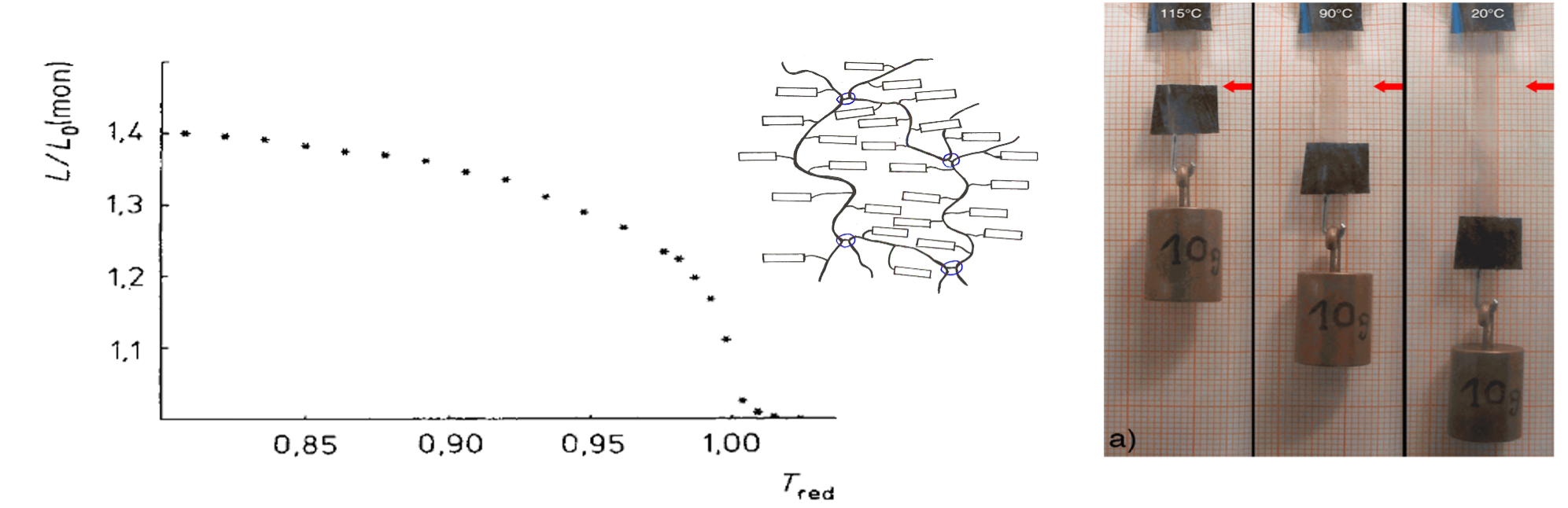
Fig. 2: (left) Change of the sample length with temperature for a Nematic liquid single crystal elastomers (temperature dependence taken from ref. [4]); change of sample length for an optimized sample (reproduced from [3], p. 63)


The realization of these mono-domain LC-elastomers (“Nematic liquid single crystal elastomers“) got possible by a two-stage crosslinking process, as presented in Fig. 3. 
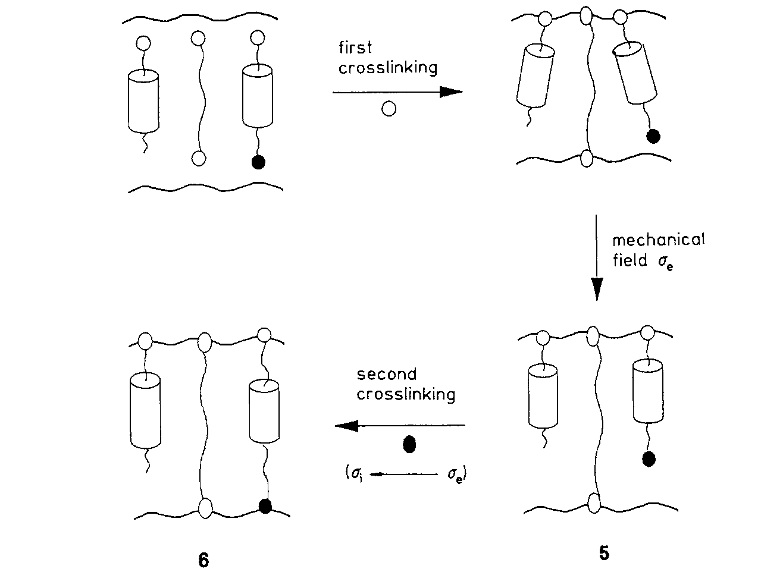
Fig. 3: Two stage process for the preparation of “Nematic liquid single crystal elastomers“) [4]; at first the reaction mixture is isotropic (diluted with solvent), for the last step it is solvent free and liquid crystalline


It is important in this context to remember that mesogens (in the LC-phase) and isotropic polymer chains do not mix (see Blog 1: The very early days of LC-elastomers (their “invention”).  So the mesogens and the siloxanes have to be hydro-silylated and crosslinked in an isotropic solvent to assure proper chemical reaction in a homogeneous medium. But in the isotropic solvent, it is not possible to orient the mesogens uniformly (the final network obtained would -under these conditions- be a polydomain sample [1,2]). Thus, in the two stage process the build-up of the elastomer is made in two steps. At first the mesogens are linked to the polysiloxane chains in the isotropic phase and also part of the crosslinking is done there. As a result a soft, isotropic, highly swollen network is obtained before the chemical reaction is finally completed. This is now (i) tried (solvent free), whereby it turns liquid crystalline. Then (ii) it is stretched (this leads now to a uniform orientation of the LC-director) and then (iii) it is allowed to react further to allow additional crosslinking to stabilize the LC-mono-domain. By this complicated process LC-elastomer mono-domains can be prepared reproducibly. And they change their shape as the order parameter of the LC-phase changes (Fig. 2). Such a change of the phase transition can also be induced by a photo-isomerization of suitable dyes.
While these “Nematic liquid single crystal elastomers“ make good actuators, it is important to remember that there is a lot of heterogeneity in them. At first part of the network is made in the highly swollen isotropic state and part in the highly stretched bulk state. As result, local chemical heterogeneities of the chemical composition (more or less mesogens per domain) may arise as the solvent is evaporated to reach the liquid crystalline phase (remember: mesogens and chains mix poorly). This shows-up at the phase transition nematic to isotropic, which is smeared out [11]. A detailed study shows that both a local variation of the strain field and of the transition temperature have to be considered [11] to describe these elastomers properly.


References
[1] Liquid crystalline elastomers - A new type of liquid crystalline material
H. Finkelmann, H.-J. Kock. G . Rehage, Makromol. Chem. Rapid. Commun. 2, 317 (1981)
[2] Liquid crystalline elastomers,
R. Zentel, Angew. Chem. Int. Ed. Engl. Adv. Mater. 28, 1407 (1989), Adv. Mater., 321(1989)
[3] Liquid Crystal Elastomers: Materials and Applications, W. de Jeu, (eds)
Adv Polym Sci 250 (2012);
[4] Nematic liquid single crystal elastomers,
J. Küpfer, H. Finkelmann, Makromol. Chem., Rapid Commun. 12, 717 (1991)
[5] The Physics of Liquid Crystals, P. G . de Gennes. Clarendon Press. Oxford
1975.
[6] Tunable Mirrorless Lasing in Cholesteric Liquid Crystalline Elastomers, 
 H. Finkelmann, S. T. Kim, A. Muñoz, P. Palffy-Muhoray, B. Taheri, 
Adv. Mater., 13, 1069 (2001)
[7] Ferroelectric liquid-crystalline elastomers
 M. Brehmer, R. Zentel, G. Wagenblast, K. Siemensmeyer
 Macromol. Chem. Phys. 195, 1891 (1994)
[8] Liquid crystalline side chain polymers and their behaviour in the electric field
 H. Ringsdorf, R. Zentel,  Makromol. Chem. 183, 1245 (1982)
[9] Shape variation of cross-linked liquid-crystalline polymers by electric fields
 R. Zentel, Liquid Crystals 1, 589 (1986)
[10] Electro-Opto-Mechanical Effects in Swollen Nematic Elastomers,
K. Urayama, Adv Polym Sci 250, 119 -146 (2012)
[11] The isotropic-to-nematic conversion in liquid crystalline elastomers, A. Lehar, G. Cordoyyiannis, Z. Kutnjak, B. Zalar, Adv Polym Sci 250, 147 – 186 (2012) 
 

The very early days of LC-elastomers (their “invention”)

Created by Alexey Eremin vor 97 Tagen um 12:05 Uhr:

Rudolf Zentel, 
Dept. of Chemistry, Johannes Gutenberg University Mainz, Duesbergweg 10-14, 
D-55128 Mainz, Germany
zentel@uni-mainz.de


The first paper about LC-elastomers was written by H. Finkelmann [1]. It dates to 1981, at which time he worked as junior group leader in the lab of Prof. G. Rehage at the TU-Clausthal. This work was soon after extended [2] by him. A bit later (1986), also R. Zentel [3] entered the field. Concerning his status, he was also a junior group leader at the University of Mainz associated with Prof. H. Ringsdorf (for comparison: he was 8 years younger than Finkelmann). While Finkelmann focused more on Physico-chemical aspects (he was working in an Institute for Physical Chemistry), Zentel tried to broader the chemical basis and the molecular structures (for an overview see Fig. 1 and [4]). He was working in Organic Chemistry. Over time, the field “flourished” and in about 1990 a lot of papers on LC-elastomers were available. For recent reviews see especially volume 250 of “Adv. Polymer Sci.” [5] and especially the chapters of Brömmel et al. [6] and Ohm et al. [7]
 
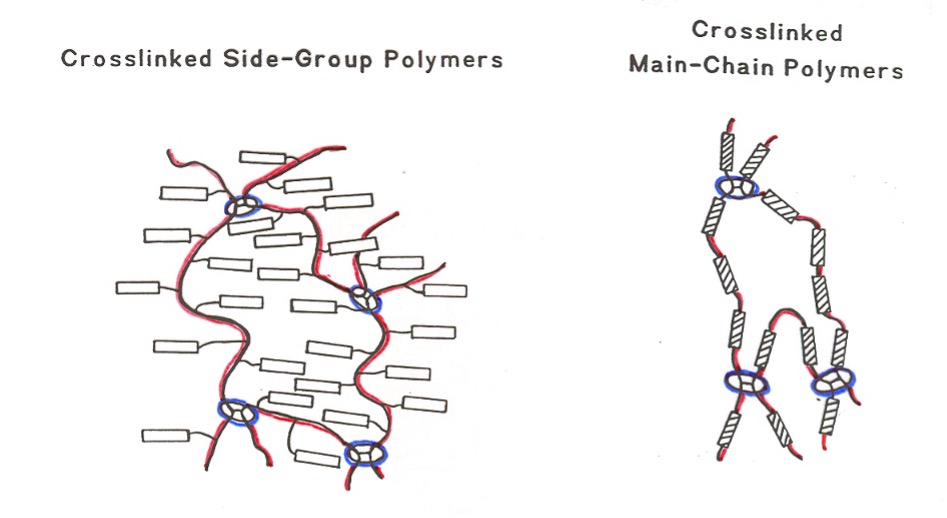
Fig. 1: Schematic representation of LC side-chain and LC main chain elastomers [4]
The polymer chains are marked in red and the crosslinks circled in blue; (original artwork of the author), structure similar to ref. [4]


Now, there was a second route to  rise the interest in LC-elastomers. These were the predictions of the properties of LC-elastomers by P.G. de Gennes [8, 9 ](1969 (in French) and 1975), which include also the possibility for a shape change (nowadays most prominent for “actuators”). He was a theoretical physicist and he got the “Nobel price” later on (generally for “theory of soft matter”). However, this work was not cited in the early synthetic papers (how to make LC-elastomers) and -if yes- then not in a prominent  way (see [4] for an exception). This aspect has been discussed recently by Jan Lagerwall [10] for the first time. This raises the question of the relevance of chemistry (to really make the materials) and theoretical predictions (of what “great properties they might show) to advance a field. LC-elastomers are a fine example to show that you need both!


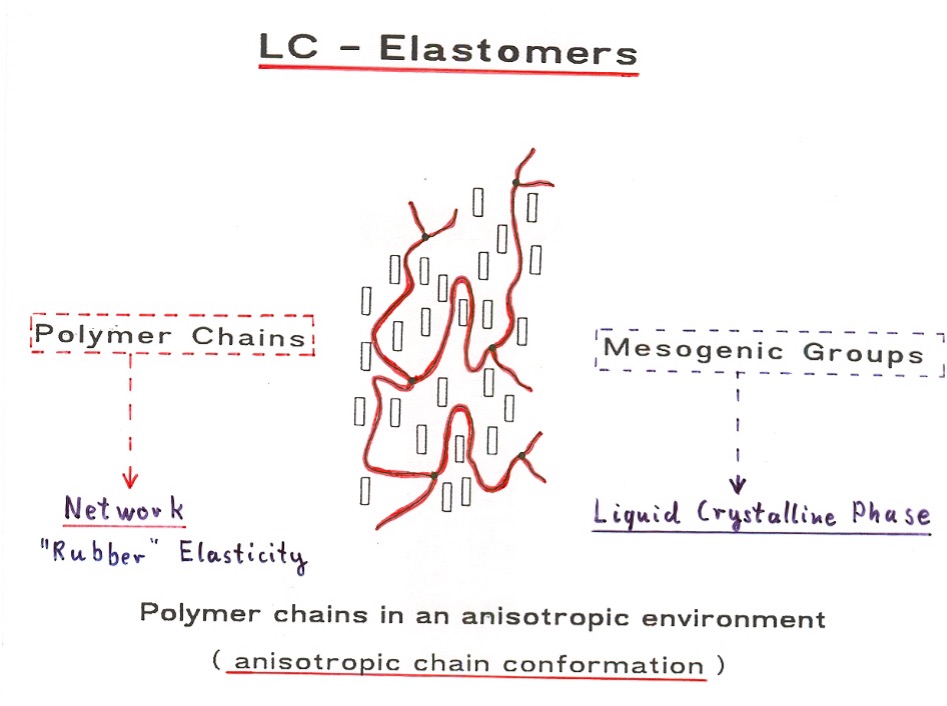
Fig. 2: Schematic picture to demonstrate the interaction of anisotropically oriented mesogens and a crosslinked polymer network (red) according to the concept of de Gennes [8, 9]. In this case (taken from [4]) it is assumed that the polymer chains try to expand parallel to the director of the mesogenic groups, which determines their anisotropic chain confirmation.


My redrawing of the ideas of the general ideas of de Gennes [8,9] are presented in Fig.  2. Independent of the type of coupling (or if there is any) mesogens and polymers will “feel each other”. In this way the polymer chains will acquire some anisotropy in the liquid crystalline phase of the mesogens. And in rubbery polymer networks (elastomers) the chain conformation determines the macroscopic size of the elastomer sample. Thus, any change of the anisotropy must lead to a shape change. So far, so good. 
But then it turned out that isotropic networks cannot be swollen with low molar mass liquid crystals in the liquid crystalline phase, see refs. [10 and 11] ( note that [11] is also ref.6 in [4]). So, networks with anisotropic liquid crystalline properties cannot be made so easily (by swelling of classical elastomers). Their preparation requires it either to find (invent) crosslinked elastomers, which are compatible (swellable) with liquid crystalline materials or to invent LC-elastomers directly. And theory cannot tell you, how to solve the challenge. But the chemical preparation [1 -5, 10] of LC-elastomers had solved the problem.


It is interesting that the early ideas of de Gennes had still an outreach, which, however, cannot be tracked today in references. At first ref. [11] cannot be accessed electronically (at least I cannot do so and I have to rely on a paper copy). Secondly, I remember having read an extended abstract from a conference in the 80´ (a paper copy in an “old” library). It described work of some German polymer scientists. They described having prepared a block of a classical elastomer and swollen it in a nematic material (from Merck) in the isotropic phase. This worked well. But as they lowered the temperature, the system phase separated into the nematic phase of the low molar mass compound and a condensed, deswollen elastomer. And because of this fact, they wrote that they could not go on to look for further promising properties. 
But this means that prior to 1979 polymer scientist had tried to do something following the predictions of de Gennes. But it had not worked. I myself are however sure that G. Rehage (the mentor of Finkelmann) know about these experiments. And in 1982 (one year after the first paper on LC-elastomers [1]) a paper was published at the TU-Clausthal [12], which shows that the new LC-side group polymers were miscible with low molar mass liquid crystals in the nematic phase. So, the experiments predicted by de Gennes could have been done. However, now LC-elastomers could be made directly [1-7] without the need of mixing/swelling.


As most of the LC-elastomers are based on LC-side group polymers, and as also LC-side group polymers demonstrate the problem of coupling two subsystems (mesogens with anisotropic orientation) and polymer chains (statistical chain confirmation) it is appropriate to discuss them briefly (see Fig. 3).


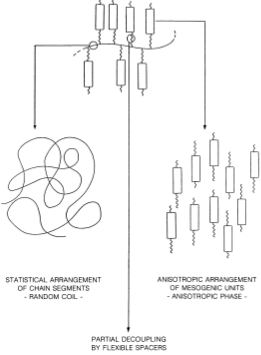
Fig. 3: LC-side group polymers [i] and the linking of mesogens and polymer coils via a flexible spacer [13]


Polymers (above a critical molecular weight) do not mix with mesogens in the liquid crystalline phase (oligomers, however, might just act like a solvent). This happens because the isotropic polymer coil will reduce the nematic order of the mesogens slightly, whilst -at the same time- the entropy of the isotropic coil is reduced by inducing an anisotropic chain conformation (this corresponds to entropy elasticity on stretching an elastomer). So somehow, both subsystems have to be synthetically coupled to prevent their demixing. On the other side, the coupling should not be too strong, as the orientational tendencies are different. This problem was solved experimentally by introducing the concept of the flexible spacer, which made LC-side group polymers accessible (see [13] for an extended review). The fascinating property of the LC side-chain polymers is, that LC phases get stabilized [13], but if the spacer is removed (Gedankenexperiment) then they would just phase separate.

References:
[1] Liquid crystalline elastomers - A new type of liquid crystalline material H. Finkelmann, H.-J. Kock. G . Rehage. Makromol. Chem. Rapid. Chommun. 2, (1981) 317.
[2] Thermoelastic and photoelastic properties of crosslinked liquid-crystalline side chain polymers  W. Gleim. H. Finkelmann, Makromol. Chem. 188, 1489 (1987).
[3] Liquid crystalline elastomers based on liquid crystalline side group, main chain  and combined polymers
 R. Zentel, G. Reckert, Makromol. Chem. 187, 1915 (1986)
[4] Liquid crystalline elastomers,  R. Zentel, Angew. Chem. Int. Ed. Engl. Adv. Mater. 28, 1407 (1989), Adv. Mater., 321(1989)
[5] Liquid Crystal Elastomers: Materials and Applications, W. de Jeu, (eds) Adv Polym Sci 250 (2012);
[6] Preparation of Liquid Crystalline Elastomers: F. Brömmel, D. Kramer, H. Finkelmann, Adv Polym Sci 250, 1-48 (2012)
[7] Applications of Liquid Crystalline Elastomers; C. Ohm, M. Brehmer, R. Zentel  Adv Polym Sci 250, 49–94 (2012)
[8] Possibilites offertes par la reticulation de polymeres en presence d’un cristal liquide. 
 Pierre-Gilles de Gennes. Phys. Lett. A, 28 (11), 725 (1969)
[9] The Physics of Liquid Crystals, P. G . de Gennes. Clarendon Press. Oxford 1975.
[10] Liquid crystal elastomer actuators and sensors: glimpses of the past, the present and perhaps the future, 
Jan Lagerwall, Programmable Materials,0,1–42 (2023)
[11]  F. Brochard. J. Phys. (Les Ulis, Fr.) 40 (1979) 1049
[12] Phase Studies of Liquid Crystalline Side Chain Polymers Mixed with
Low Molar Mass Liquid Crystals of Similar Structure
H. Finkelmann, H.-J. Kock and G. Rehage
Mol. Cryst. Liq. Cryst.,  89, 23 (1982)
[13] Liquid Crystalline Polymers, R. Zentel  in: Liquid Crystals, H. Stegemeyer (Editor), Steinkopff Verlag Darmstadt 1994,  103 - 140


A tribute to Wim de Jeu (WILHELMUS HENDRIKUS DE JEU)

Created by Alexey Eremin am 17.06.2026 um 15:12 Uhr:

The German Liquid Crystal Society mourns the passing of Prof. Wim de Jeu, who died on 3 June 2026.

Wim de Jeu was an inspiring scientist, who worked in the area of soft matter physics whereby he focused on “self-organized” materials, mostly of liquid crystalline nature. He was born 1943 in Leersum (NL) and died recently in Heerlen, NL (June 3rd 2026) at the age of 83. 
Over all, he got famous for his “physical view” on new liquid crystalline materials and the use of refined (X-ray) scattering methods to characterize various smectic phases. In addition, he had a great interest in structure – property relations, which made him an ideal partner for synthetic groups (see the list of his scientific activities, (Link).). In this respect he was essential to the characterization and further development of the new polymeric liquid crystalline compounds. This brought him in close contact with LC-groups in Halle (Fischer), Freiburg (Finkelmann) and Mainz (Zentel). In this context he studied the effect of polymer-networks and their crosslinking points in liquid crystalline elastomers [1, 2] and of phase separation in liquid crystalline block-copolymers [3]. Finally he was awarded the “Alfred Saupe Award” in 2018 at the annual meeting of the “German Liquid Crystal Society” (see Fig. 1). The laudation presented for this purpose is enclosed (Link).


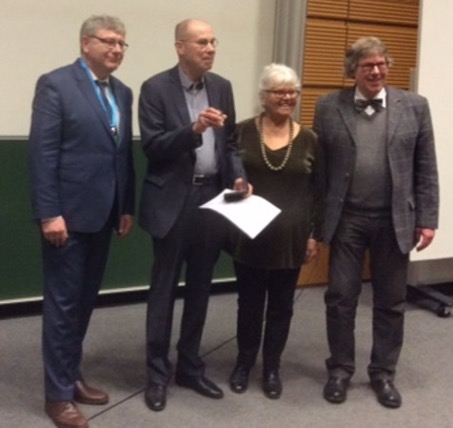
Fig. 1: Awarding the Saupe Medal to Wim de Jeu, from left: Frank Giesselmann, Wim de Jeu, Brigitte Saupe (widow of A. Saupe) and Rudolf Zentel


It should be noted that besides his scientific activities Wim de Jeu was also very actively engaged in the education of students and the promotion and training of young up-coming scientists. This showed up by his engagement in the “establishment of the Science Department” at the “Open University of the Netherlands” (1984 -94) for which he acted as dean of the faculty and in the fact that he wrote three books on his topics (Physical Properties of Liquid Crystalline Materials; Liquid Crystal Elastomers, Materials and Applications; Basic X-Ray Scattering for Soft Matter). In addition he used -at the end of his career- much time at the University of Mass. at Amherst and at the TH Aachen for the training of students.

 
[1] Induced long-range order in crosslinked "one-dimensional" stacks of fluid monolayers
 G.C.L. Wong, W. de Jeu, H. Shao, K.S. Liang, R. Zentel
NATURE 389, 576 - 579 (1997); https://doi.org/10.1038/39271
[2] Order and Disorder in Liquid-Crystalline Elastomers,
 WH de Jeu, BI Ostrovskii, 
 Adv. Polym. Sci., 250, 187-234 (2012); DOI 10.1007/12_2010_105

[3] Orientational Wetting in Hybrid Liquid Crystalline Block Copolymers
G.C.L. Wong, J. Commandeur, H. Fischer, WH de Jeu, Phys. Rev. Lett. 77, 5221 (1996); DOI 10.1103/PhysRevLett.77.5221


written by Rudolf Zentel

Wolfgang Helfrich (1932–2025)

Created by Alexey Eremin am 30.03.2026 um 15:51 Uhr:

The liquid crystal and soft matter community has lost a scientist whose work has had a lasting influence on the field. Wolfgang Helfrich, who passed away in 2025, made fundamental contributions to both liquid crystal research and biophysics.

After studying physics in Göttingen, Munich and Tübingen, and completing his doctorate at the Technical University of Munich in 1961, Helfrich worked in Munich, Ottawa, and at the RCA Laboratories in Princeton. Following his habilitation in 1967, he returned to RCA, where he began developing theoretical ideas on the structure of liquid crystals.

In 1970, at Hoffmann-La Roche in Basel, Helfrich — together with Martin Schadt — developed the first twisted nematic liquid crystal display (LCD). This concept became the basis for a technology that is now used in billions of devices worldwide.

In parallel, Helfrich made important contributions to the physics of membranes. His 1973 paper introduced what is now known as the Helfrich energy, a curvature-based description of membrane elasticity that remains central in biophysics. In the years that followed, he developed key ideas on membrane fluctuations, entropic interactions, and vesicle shapes, which continue to influence research across disciplines.

From 1973 until his retirement in 1997, Helfrich was Professor of Experimental Physics at the Free University of Berlin. He received several distinctions for his work, including the Robert-Wichard-Pohl Prize of the German Physical Society and, in 2012, the Draper Prize of the US National Academy of Engineering.

Wolfgang Helfrich combined theoretical depth with a strong sense for physical problems. He moved between fundamental questions and practical applications and was known for his independent thinking and his critical view of rigid academic and industrial structures.

He will be remembered as a scientist who opened new perspectives in the study of liquid crystals and membranes, and as an inspiration to colleagues and students.


The German Liquid Crystal Society (GLCS / DFKG) honours his memory with respect and gratitude.

Page 1 of 2 1 2

Last Modification: 03.09.2025 -
Contact Person: